Every Nonprofit Grows Up the Same Way
The stages of the nonprofit lifecycle, what each one demands, and how to navigate it well
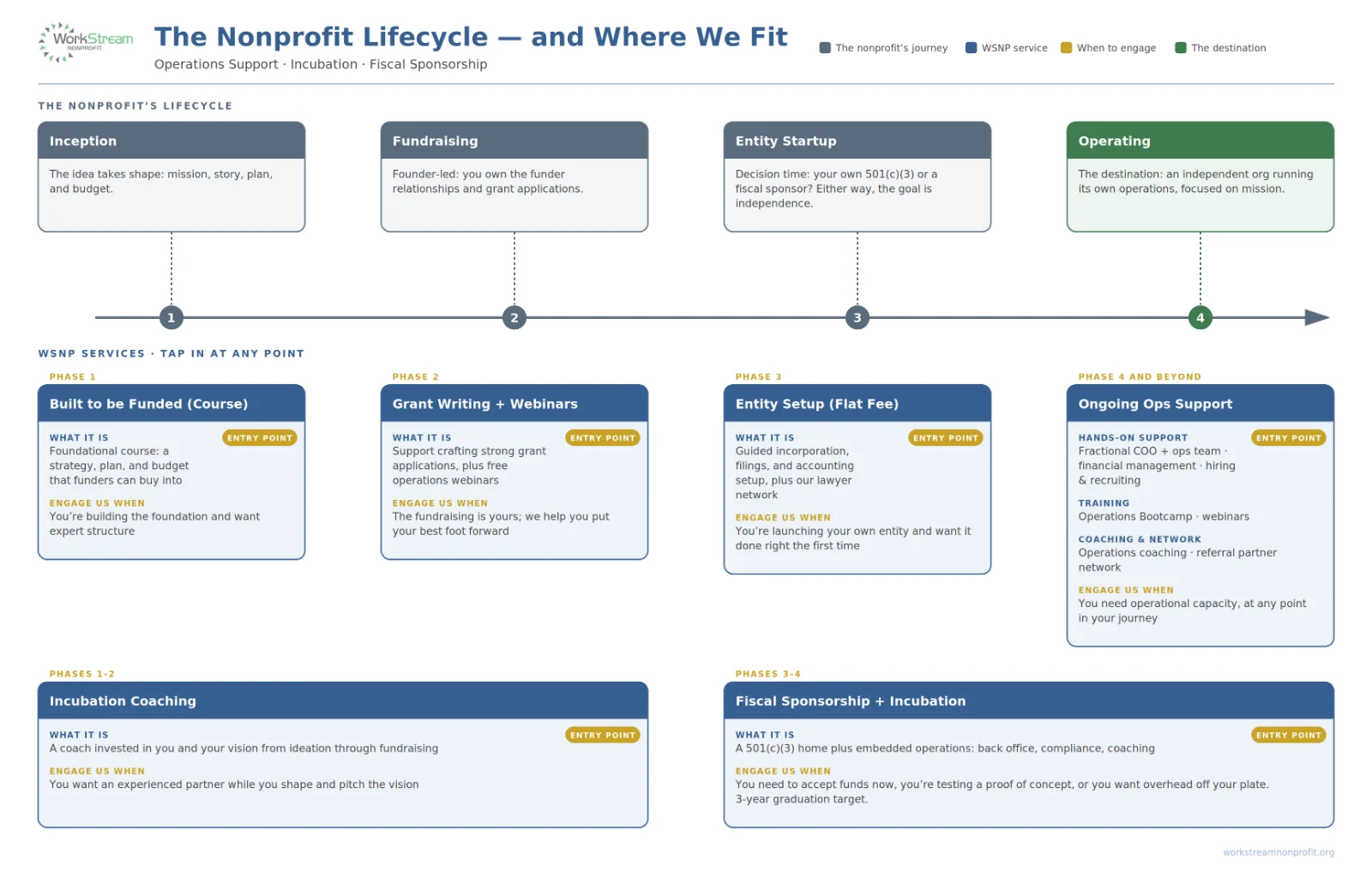
Before we start, we have some exciting news: we’re adding fiscal sponsorship to our programs! Our goal is to combine incubation, fiscal management, and infrastructure development to increase impact.
One of the most common questions I get from new nonprofit leaders is, “I’m ready to start my nonprofit, but I don’t know what to do next.” So here’s a guide to the phases of nonprofit development, and what to expect in each phase. I’ve included sections about what artifacts you’ll need to create, common mistakes, and tips for success. Where applicable, I’ve also indicated where we can help support you. Most of our programs were developed in reaction to a need we saw.
Phase 1: Inception
You have an idea. You know the change you want to see in the world. You see a problem, you see a pathway to fix it, and you have plans to change the world. At this phase, you’ll want to focus on storytelling - making your mission and vision clear, articulated well, and supported with data and concrete plans to give form to your vision. In this phase, you’re also pre-funding, and part of acquiring funding is making sure you have a plan your funders can buy into and a budget that supports it well.
Artifacts you’ll need to create:
- Mission statement
- Theory of change
- Annual plan with OKRs (objectives and key results)
- Data points to indicate success
- Preliminary budget
- Business plan
Common mistakes:
- Not adding enough money in the budget for overhead costs (like payroll, fiscal sponsorship, insurance, etc.)
- Assuming that funders will have faith in your plan on the strength of your vision
- Not thinking through how you’re going to accomplish your mission well. I want a step-by-step flow of what you’re planning on doing, with whom, and how. This will inform budget and metrics, and give your funders more confidence in your plan.
- Not evaluating the landscape. Are there others already doing similar work? What makes you different? Sometimes it’s more effective to add your program to an existing org, not create a new one.
Some general tips:
- Be clear. The curse of the expert will follow you around. Use simple and concise language to describe your impact and plans so that an average middle school student can understand it. Keep asking, “why?” If you haven’t seen it, refer to Simon Sinek’s TED Talk on “Start with Why.”
- Avoid heavy LLM (AI tools like Claude and ChatGPT) usage. LLMs are really good thought partners, but your funders want to see your plans, not Claude’s. I also find that overreliance on LLMs means people don’t present concrete plans well, since those need to be developed by you.
- Get feedback early. Talk to potential partners: people in the field, similar orgs, etc. Keep a learning mindset and adapt to what the feedback indicates.
- Start small and large. Practically, you want to start off with a pilot or beta version of your full programming. That’s the small part. What can you implement now, with little or no support? It’s the MVP (minimum viable product). But also think big. What’s your objective? What can you achieve if you get your aspirational funding? That’s your ask.
Resources we offer to support you:
Phase 2: Fundraising
You have all your materials ready. You have a great plan, and hopefully some data to back you up. This is the part where you’re speaking to potential funders to gauge interest in supporting your mission and submitting grant applications.
Artifacts you’ll need to create:
- Grant application template: Once you have a template, the next applications will be much easier.
- One-pager LOI: Tell your story in 1 page (max 2) so funders can quickly review your plans and evaluate alignment.
Common mistakes:
- Don’t assume grant funding is easy to get. It takes strategy and time. You’ll want to find a personal backer for the first couple of years. Yes, that means talking to people and selling them on your mission.
- Be thorough about producing the documents mentioned above in phase 1. Yes, you do need them, and they are important, and you’re more likely to get funding if you’re presenting your organization as professional and well run.
Some general tips:
- It’s hard to get that initial funding. Outside of the EA community, most funders won’t touch orgs that have been around for less than 2-3 years. It’s risky. Try to find people who believe in your mission, or bootstrap a pilot to prove success, which will in turn make you more fundable. Another option is to work with partners that have a proven track record.
- If you do get seed funding, don’t assume that it will be renewed. Many seed funders don’t continue support past the first year. It’ll be up to you to prove your worth and diversify your fundraising early on.
- Maintain the perspective that you’re offering potential funders the opportunity to support a cause that’s important to them. That changes the fundraising conversations to be one of partnership, not of begging.
- Funders are looking at you as an investment. How likely is it that you’ll be able to realize the impact they want to see? In all, your conversations and presentations show them why they should have confidence in you. As much as you can, point to past performance and indicators that validate that claim.
Our Fiscal Sponsorship Program Opens in September
If your organization needs a legal home for funding before it has the capacity to run its own back office, this is what we built it for.

You get a 501(c)(3) home for grants and donations, and we help incubate your organization. We'll handle all the finance and compliance, and bundle it with incubation coaching, training and startup support to give your mission the support it needs to thrive from day one.
Some organizations use sponsorship as a bridge to independence. Others stay for the long run. And some just need help getting their organization off the ground. We can help you work out which pathway fits your organization and help you along the way.
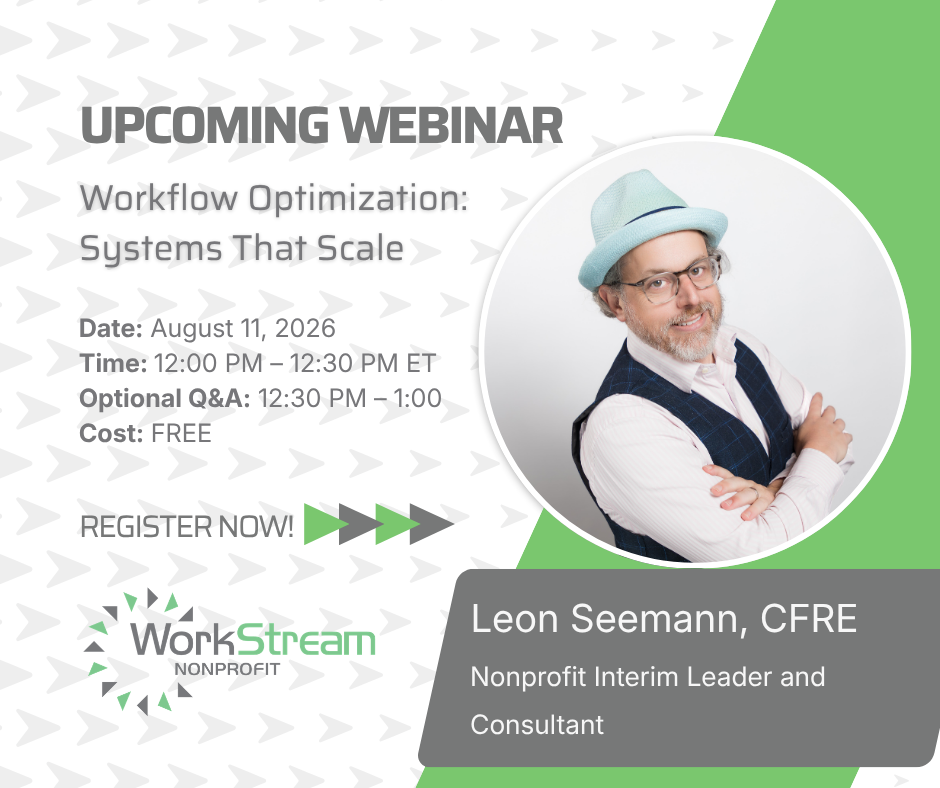
Tuesday, August 11
12:00 PM - 12:30 PM EST
Leon Seemann, CFRE, brings nearly 30 years of experience helping nonprofits grow and thrive as an interim CFO, COO, and Executive Director, along with certifications in nonprofit consulting, human resources, and interim leadership.
Join us on Tuesday, August 11th for a free session designed to help you move forward without second-guessing what compliance requires of your organization.
This session is focused on implementation. You will leave with tools you can apply right away, along with the opportunity to ask questions during live Q&A.
We look forward to partnering with you to establish your nonprofit's operational infrastructure to scale and thrive!
Deena Englander
WorkStream Nonprofit
Empowering Nonprofits for Sustainable Success
www.workstreamnonprofit.org
443-379-4105
deena@workstreamnonprofit.org
www.linkedin.com/in/deenaenglander
Click here to schedule a time to talk with me